What is Cloider?
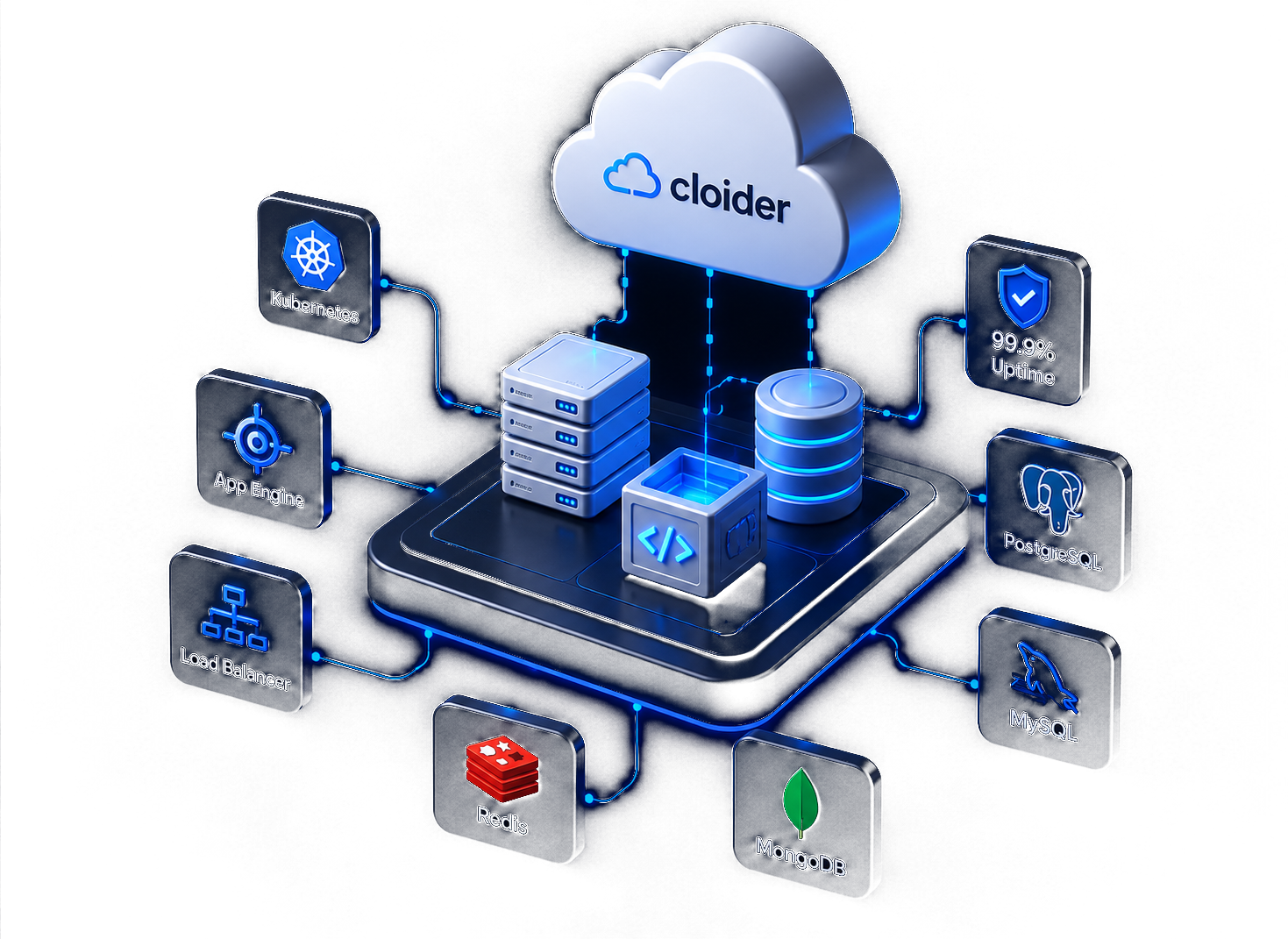
Cloider is a pay-as-you-go cloud platform. On one account you can deploy apps, run serverless Kubernetes clusters, and use managed PostgreSQL, MySQL, MongoDB and Redis databases, S3-compatible object storage, a private container registry, DNS, domains, volumes and load balancers. You manage everything from the dashboard, the cloider CLI, Terraform, the REST API or an AI agent over MCP.
How does Cloider pricing work?
You pay as you go from prepaid funds, with no plans to commit to and no upfront fees. Running resources are priced at monthly rates prorated to the second. Apps and Kubernetes clusters are billed in compute units of 1 vCPU or 3 GB of memory, whichever is larger, at $35 per unit per month, for the larger of what each container requests and what it actually uses. Databases have fixed plans from $3.99 per month. Object storage costs $0.25 per GB per month. Egress, API and S3 requests, registry pulls and DNS hosting are free.
Is there a free trial?
Yes. Sign up with Google or GitHub and claim the $25 welcome credit from the dashboard, which starts a 14-day trial. After that you add funds to your balance and keep paying only for what you use.
Do I need to know Kubernetes to deploy an app?
No. Cloider App Engine deploys a GitHub, GitLab or Bitbucket repository, a folder on your computer with cloider deploy, or a Docker image from any registry. It builds with your Dockerfile or with buildpacks for Node.js, Python, Go, Java, PHP, Ruby, .NET and static sites, serves the app over HTTPS on a free cloider.app subdomain or your own domain, redeploys on every push and scales up to 20 replicas. Apps can also run as cron jobs.
How is Cloider's serverless Kubernetes different from EKS, GKE or AKS?
On Amazon EKS, Google GKE or Azure AKS you normally provision worker nodes and pay for them whether your pods use them or not. A Cloider cluster has no nodes to size, patch or scale. You get the standard Kubernetes API for kubectl and Helm, and each container is billed for the larger of its resource request and its actual use. You can pause a cluster to stop paying for compute while its objects and volumes are kept.
Which databases does Cloider offer?
Managed PostgreSQL, MySQL, MongoDB and Redis, with plans from $3.99 per month. Each database is its own isolated server with its own storage. Cloider takes a full backup every 14 days and records every change in between, so you can restore the newest data or any point in time from the last 14 days into a new database. Connections can use TLS, trusted sources decide who can reach the public endpoint, and your Cloider apps and clusters connect over a private host.
Can AI coding agents manage Cloider?
Yes. cloider mcp is a Model Context Protocol server for Claude Code, Cursor, Claude Desktop and any other MCP client, and cloider mcp --read-only limits an agent to reading. Every MCP tool says whether it reads or deletes, so agents ask before destructive changes. The CLI prints JSON with -o json, never waits on a prompt without a terminal, and read-only API tokens keep scripts and agents to reads.
Does Cloider charge for egress or bandwidth?
No. Data transfer out, API and S3 requests, registry pulls, DNS hosting and cloider.app subdomains with HTTPS are free. You pay for compute, storage, database plans and load balancers ($10 per month each).
Can I move my workloads off Cloider later?
Yes. Clusters run standard Kubernetes, buckets speak the S3 API, and databases are standard PostgreSQL, MySQL, MongoDB and Redis, so your manifests, Helm charts, S3 tools and database dumps work anywhere. With free egress, moving your data out costs nothing.